
Privacy Disclosure Statement
Cyproheptadine
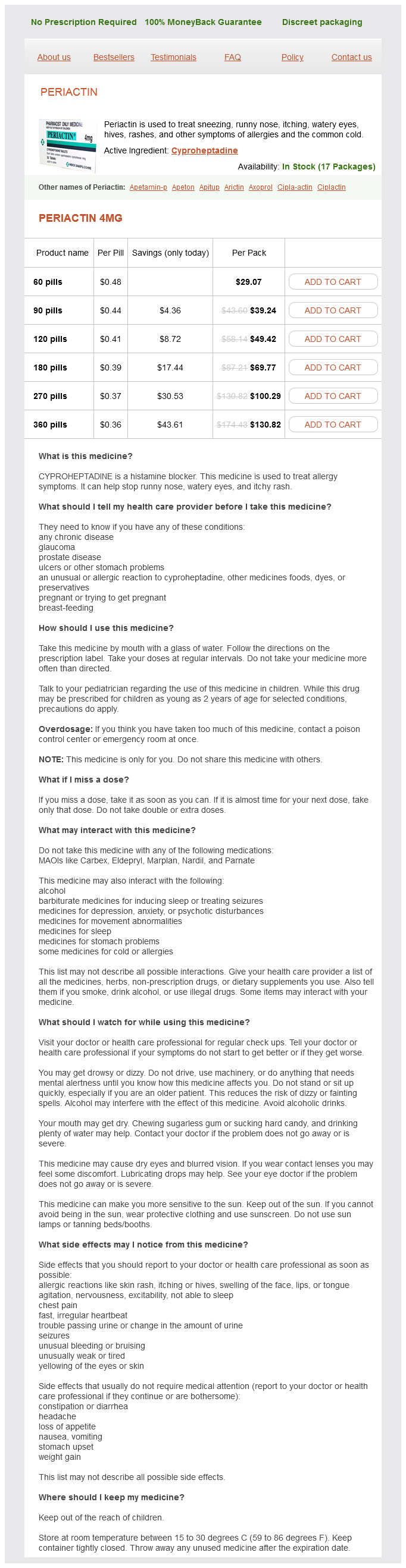
Periactin 4mg
- 60 pills - $29.07
- 90 pills - $39.24
- 120 pills - $49.42
- 180 pills - $69.77
- 270 pills - $100.29
- 360 pills - $130.82
Cyproheptadine dosages: 4 mg
Cyproheptadine packs: 60 pills, 90 pills, 120 pills, 180 pills, 270 pills, 360 pills
Only $0,39 per item
In stock: 724
Description
Which anatomic allergy drops austin 4 mg cyproheptadine best, clinical allergy medicine nightmares cyproheptadine 4 mg without prescription, and radiographic options will affect the choice for surgical method What post-operative measures should be applied in anticipation of surgical compromise to the endocrine system What intraoperative findings might influence extent of surgical resection and wish for adjuvant therapy within the post-operative period Surgical Procedure the patient is introduced into the operating room allergy forecast boston cyproheptadine 4 mg cheap with amex, and general anesthesia is initiated allergy shots diarrhea cyproheptadine 4 mg visa. Intravenous entry is obtained, contemplating the potential want for fluid resuscitation 211 2 1 Pediatric Neurosurgery ought to diabetes insipidus manifest intraoperatively. An arterial line is placed, and the patient is given a preoperative dose of dexamethasone 0. Positioning of the affected person is supine, with the pinnacle in extension with lateral turn to the left, and secured in 3-point pin fixation. A curved coronal incision is deliberate from the root of the zygoma to the contralateral paramedian region behind the hairline. Scalp is rigorously elevated, with interfascial dissection deep to the superficial temporal fat pad to be able to shield the frontal department of the facial nerve. A frontotemporal craniotomy with inclusion of the orbital rim from the supraorbital foramen/notch to the frontozygomatic suture is elevated in 1 piece. Although a single-piece craniotomy entails more extensive osteotomies to release the flap from the orbital roof, wall, and sphenoid wing, the postoperative beauty consequence is superior to a 2-piece bone flap. Removal of the orbital rim improves exposure of the posterior tumor capsule near the hypothalamus and basilar artery. Care is taken to leave the periorbital dura intact in order to avoid injury to the orbital contents. If the frontal sinus is uncovered, it can be superficially occluded with muscle and coated with a vascularized pericranial flap. Extradural bone elimination from the skull base is carried out utilizing a high-powered drill. The orbital roof is drilled flat and thinned, the medial sphenoid ridge is removed right down to the meningoorbital band. The band is coagulated, divided, and extradural dissection right down to the anterior clinoid and optic canal is performed. Removal of the anterior clinoid permits significantly improved visualization into the sella. The lateral roof of the optic canal is opened, and the optic strut is detached from the sphenoid bone. The inside wall of the clinoid is then thinned until it might be fractured off with microforceps and removed. These measures, along with the bony elimination, will reduce or utterly eliminate any need for retraction on the frontal lobe. The center cerebral artery is recognized within the Sylvian fissure and adopted to the carotid bifurcation. The vascular anatomy must be recognized and protected early on within the procedure. After identification of the tumor capsule, the cyst is aspirated, taking care to avoid spillage of cyst contents into the subarachnoid house, as this will induce a potent inflammatory response. The tumor resection is then carried out utilizing inside debulking of stable and cystic elements adopted by meticulous extracapsular dissection from surrounding neurovascular structures. If the pituitary stalk can be preserved and thoroughly dissected from the tumor capsule, it ought to be left intact. Vascular constructions of the circle of Willis could have formed significant adhesions to the tumor both from prior leakage of cyst contents, or via embedded calcified capsule into the wall of the artery. A small quantity of residual tumor capsule must be left behind in these situations, quite than danger a serious vascular harm. The basilar artery is normally protected by the membrane of Liliequist; nonetheless, distal tumor manipulation should be minimized until access to the vascular constructions has been obtained with ongoingtumorremoval. Any spasm of main cerebral arteries ought to be managed with papaverine pledgets and irrigation until resolved. The dura is closed in watertight trend and tack-up sutures are positioned to keep away from epidural fluid collection. The bone is secured with titanium microplates, making certain the orbital rim is lined up perfectly. Any large cranial gaps should be crammed with bone putty to ensure optimum beauty result. Every attempt ought to be made to achieve full resection of the tumor without unacceptable neurologic compromise. If tumor is severely adherent to the hypothalamus or important vascular buildings, the goal of the surgical procedure must be changed to maximal protected resection. A thin rim of adherent capsule is left attached to the artery in order to shield the affected person from vital surgical morbidity. Adjuvant radiotherapy can be effective for long-term control with small amounts or residual tumor. Surgical strategy is chosen primarily based on presence of pneumatized sinuses, location and lateral extent of tumor, suspicion for vascular adhesions to the tumor capsule, and lateralization of preoperative visible deficit. Removal of the orbital rim and anterior clinoid, along with drilling of bone at the skull base, will enable for optimal visualization of peritumoral anatomy, and avoidance of retraction on the frontal lobe throughout tumor resection. An wonderful cosmetic end result may be achieved with attention to dissection and reconstruction methods. The scalp is elevated after interfascial dissection of the superficial fat pad for defense of the frontal department of the facial nerve. The function of the hypothalamus must be prioritized over efforts to protect the pituitary stalk. Hourly neurologic checks are performed and the amount standing is strictly recorded. Diabetes insipidus ought to be anticipated in the majority of patients, and brief interval electrolytes, urine osmolality, urine particular gravity, and fluid deficit assessments are initiated. Endocrinology will assess hormonal function within the immediate and ongoing postoperative period, as some deficits might demonstrate late presentation and even resolution. A post-operative dexamethasone taper is completed, followed by initiation of hydrocortisone replacement remedy till the function of the hypothalamic-pituitary-adrenal axis has been established. Long-term endocrine follow-up and care is critical in the pediatric population to ensure optimum progress and maturation. Adjuvant therapy, when needed, may be planned after a number of weeks of wound therapeutic. Complications and Management Post-operative worsening of endocrine status is predicted in most cases. Long-term damage to hypothalamic function, particularly the satiety facilities, should be monitored for as the patient grows. Significant neurovascular accidents can typically be averted with cautious preoperative planning and good surgical approach. Distal tumor manipulation throughout resection ought to be prevented, as any avulsion of a vascular wall shall be troublesome to repair if tumor bulk prevents access to the bleeding vessel. If preliminary dissection of the tumor reveals significant prior scarring within the suprasellar region, vascular clips should be made available for any potential surprising harm. Such an injury must be primarily repaired and patency of the vessel verified with Doppler to keep away from a catastrophic ischemic event. Hydrocephalus, if current at presentation, could be managed intraoperatively with a quick lived ventricular drain. Treatment-related morbidity is acute with surgical intervention, and requires instant postoperative management within the intensive care unit. Radiotherapy is associated with delayed treatment morbidity, and may embody vasculopathy, secondary malignancy, vision loss, endocrinopathy, or neurocognitive impression. Long-term monitoring of these sufferers by a multidisciplinary pediatric brain tumor staff, including endocrinology, is necessary to optimize last consequence and high quality of life. Inadequate tumor control after preliminary treatment will lead to inevitable recurrence, with more complex and fewer efficient remedy options, and higher associated remedy morbidity. Every effort should be made to obtain permanent tumor management with the preliminary intervention. Unexpected intraoperative problems, such as neurovascular harm, can be averted with cautious preoperative planning and good surgical approach. Peritumoral arteries ought to by no means be sacrificed in the setting of damage, and microvascular repair shall be needed should this happen.
Flatspine Prickly Ash (Chinese Prickly Ash). Cyproheptadine.
- Dosing considerations for Chinese Prickly Ash.
- What is Chinese Prickly Ash?
- Pain, vomiting, diarrhea, abdominal pain, snakebite, skin diseases, and other conditions.
- How does Chinese Prickly Ash work?
- Are there any interactions with medications?
Source: http://www.rxlist.com/script/main/art.asp?articlekey=97065
Indications and rules for surgical procedure � � � � � Involvement of the ascending aorta allergy juice recipe cyproheptadine 4 mg generic line. Progression (continued pain allergy medicine diphenhydramine cyproheptadine 4 mg buy on line, growth of haematoma on further imaging milk allergy symptoms in 3 year old cyproheptadine 4 mg generic without a prescription, loss of pulses allergy symptoms 7 months cyproheptadine 4 mg order mastercard, pericardial rub, or aortic insufficiency). The purpose of surgical remedy is to replace the ascending aorta, thereby preventing retrograde dissection and cardiac tamponade (main explanation for death). Indications and rules for medical management Medical therapy is the therapy of alternative for: � Uncomplicated sort B dissection. The objective is to stop the unfold of the intramural haematoma and to prevent rupture. Vasodilators within the absence of -blockade could enhance myocardial contractility and the speed of rise in strain (dP/dt). Emerging indications and ideas for interventional therapy There are growing reports and short case sequence demonstrating beneficial outcome (prognostic as properly as symptomatic) information on utilizing endovascular stent grafts in the administration of primarily type B and likewise, to a lesser extent, sort A aortic dissections. On the premise of current evidence, endovascular stent grafts ought to be considered to seal the entry to the false lumen and to enlarge the compressed true lumen within the following conditions: � Unstable sort B dissection. Cardiac tamponade If the affected person is comparatively secure, pericardiocentesis may precipitate haemodynamic collapse and must be avoided. The affected person ought to be transferred to the working theatre for direct repair as urgently as attainable. We recommend admission of most patients for statement for issues, especially effusions, tamponade, and myocarditis. Indometacin ought to be avoided in adults, as it reduces coronary move and has marked side effects. Stop if the affected person develops diarrhoea and nausea (1mg stat, 500 micrograms q6h for 48h). Steroids must be prevented, except indicated as a part of remedy for the underlying trigger. The presentation is dependent upon the velocity with which fluid accumulates inside the pericardium. Acute tamponade might occur with 100�200mL in a comparatively restricted pericardial sac. Chronic pericardial collections could contain as a lot as 1000mL of fluid with out clinical tamponade. This may be so marked that the pulse and Korotkoff sounds could additionally be completely misplaced throughout inspiration. Deflate the cuff gradually till the first beats are heard and maintain the pressure at that level, concentrating on the disappearance and reappearance of sounds with respiration (bump�bump, silence�silence, bump�bump, where noise displays expiration). Continue to deflate slowly, listening to the same sample till all beats are audible. With slower accumulation of pericardial fluid (>250mL), the cardiac silhouette will enlarge with a globular appearance. In the event of circulatory collapse, drainage must happen immediately without imaging. This requires either a change in therapy of the underlying cause or a proper surgical drainage process corresponding to a surgical pericardial window or pericardiectomy. However, observe local tips and liaise with the local congenital coronary heart illness cardiologist. Generally, contemplate phlebotomy provided that average or severe signs of hyperviscosity are current and haematocrit is >65%. Remove 500mL of blood over 30�45min, and exchange the volume concurrently with 500�1000mL of saline, or salt-free dextran (if coronary heart failure). Skin stitches for operative procedures ought to be left in for 7�10 days longer than normal. Any site of sepsis may result in cerebral abscesses from metastatic infection or septic emboli. Arterial thrombosis, embolic events (paradoxical emboli in right-to-left shunt), and injudicious phlebotomy result in spontaneous thrombosis. Any injured brain tissue can additionally be a nidus for intracranial infection/ abscess formation. Contrast brokers might provoke systemic vasodilatation and cause acute decompensation. Before non-cardiac surgery, attempt to optimize the haematocrit and haemostasis by controlled phlebotomy and substitute with dextran. In sufferers with right-to-left shunt, megakaryocytes bypass the pulmonary circulation and turn out to be trapped in systemic vascular beds, promoting new bone formation. Possibilities embody valve dysfunction (calcification of an irregular valve or secondary to supra- or subvalvular fibrosis and stenosis), ventricular dysfunction (hypertrophy, fibrosis, and failure), dysfunctioning surgical shunt, or pulmonary arteriolar illness and shunt reversal. The really helpful antibiotic prophylaxis routine is given under E Endocarditis prophylaxis, p. Do not give giant doses of diuretics or nitrates, as this will drop systemic pressures and will precipitate an acute collapse. It requires cautious analysis with the conventional diagnostic modalities already described. For an inventory of causes of cyanosis in adults with congenital coronary heart illness, see Box 1. Severity assessment � Severity assessment is the key to deciding the positioning of care. Further studying British Thoracic Society, Community Acquired Pneumonia in Adults Guideline Group. Guidelines for the management of community acquired pneumonia in adults: update 2009. Aspiration pneumonia � Risk elements embrace: seizures, reduced conscious degree, stroke, dysphagia, periodontal disease, alcohol dependence, basic anaesthesia, and nursing house residents. Hospital-acquired pneumonia � Most likely organisms are enteric Gram �ve micro organism � anaerobes. Parapneumonic pleural effusion or empyema � Parapneumonic pleural effusions develop in as a lot as 50% of patients with bacterial pneumonia admitted to hospital. Incubation 2�10 days, followed by excessive fever, rigors, headache, myalgia, dry cough, progressive respiratory distress, and confusion. Abdominal ache, diarrhoea, nausea and vomiting, and palpable hepatomegaly are seen in 730%. Diagnosis: rise in specific IgM and immunoglobulin G (IgG) titres (urine, blood, sputum). However, some patient groups/ indicators and signs are inclined to be extra generally associated with certain pathogens: � S. There is often a historical past of publicity to the allergen, and serum precipitins are detectable. The trigger could additionally be unknown, as in cryptogenic eosinophilic pneumonia, or it could be due to medicine. Ascaris lumbricoides, hookworms, Strongyloides stercoralis), tropical pulmonary eosinophilia (lymphatic filarial infection), or small-vessel systemic vasculitis (Churg�Strauss). Allergic bronchopulmonary aspergillosis this is a hypersensitivity response of airways colonized by Aspergillus spp. It usually occurs in asthmatics with repeated episodes of bronchial obstruction, inflammation, and mucus impaction, resulting in bronchiectasis and upper lobe fibrosis. Such sufferers are usually Aspergillus skin-prick check [immunoglobulin E (IgE)] and serum precipitins (IgG) constructive. Characteristically, infiltrates in numerous lobes over completely different time courses, or pneumonia unresponsive to antibiotics. Alveolar haemorrhage Intrapulmonary haemorrhage might current with cough, fever, and breathlessness. Acute assaults might construct up over minutes, hours, or days, and the sufferers might deteriorate very quickly and current as respiratory or cardiorespiratory arrest. Precipitants � No clear precipitating cause may be recognized in over 30% of sufferers.
Specifications/Details
We prefer twin agent coverage with clindamycin and cefuroxime which is then continued for 72 hours postoperatively allergy quinine symptoms 4 mg cyproheptadine with amex. Depending on the age and dimension of the kid allergy shots reactions swelling cyproheptadine 4 mg cheap mastercard, an in depth plan for minimizing blood loss allergy testing jersey cyproheptadine 4 mg generic otc, and managing intraoperative anemia should be mentioned allergy symptoms chest pain 4 mg cyproheptadine trusted. A bicoronal pores and skin incision and subgaleal dissection expose the frontal periosteum which is then elevated as a separate vascularized layer for potential use as a graft during closure. A bifrontal craniotomy is carried out with care taken to keep away from harm to the sagittal sinus. In younger youngsters, the relatively shallow anterior fossa and lack of frontal sinuses usually enable for an sufficient publicity without removal of the orbital bar, though extra advanced lesions can require this. Alternatively, for lesions with extra restricted intracranial involvement and no intradural extension, a subcranial bony exposure can be carried out with the bony incisions made superiorly simply above the orbital bar, laterally via the supraorbital rims. Endoscopic endonasal approaches to the anterior cranium base have additionally been used, though in young children entry can be considerably difficult. Intracranial dermoid material can then be removed, usually extending into the foramen cecum, where the tract will generally extend transcranially into the nasal subcutaneous tissue. Depending on the nature of the lesion, exposure of the crista galli can be needed. If a durotomy has been required or occurred, primary repair can be augmented by pericranium moved both as a vascularized pedicle or as a free transfer, with the former requiring at least a small hole within the bony reconstruction for passage. Since dermoid sinus tracts have been described with only intermittent presence of dermal components alongside the fibrous tracts, this strategy is greatest used when the pre-test chance of intracranial extension is comparatively low by preoperative radiology. The case affected person presented here underwent a mixed transnasal excision of the pit and nasal portion of the sinus, with bifrontal craniotomy to tackle the intracranial dermoid cyst. He made an uneventful recovery, with no recurrence evident on follow-up imaging at 2 years post procedure. The major objective of surgical management is complete excision of the lesions, together with the punctate pores and skin opening, if present. Lesions with out trans-osseous involvement are sometimes managed via direct vertical nasal incision alone, although endonasal and subgaleal endoscopic techniques are also used. For resections for which the neurosurgeon offers pre-operative consultation only, the discussion ought to give consideration to how inadvertent durotomy is to be avoided, acknowledged, and managed. For lesions with intracranial extension, a group strategy involving both neurosurgery and a nasal surgeon (typically a plastic surgeon or otolaryngologist) yields the best results. Lesions with trans-osseus extension of a dermoid sinus tract with minimal intracranial cystic growth can often be eliminated by way of an open transansal approaches, often using an open rhinoplasty approach. Small osteotomies that preserve the stalk can be utilized to expose stalk base which might then be separated from the dura with out incision. The dural surface on the point of contact with the stalk is curetted and sometimes coagulated to make sure no residual dermal cells are present. Lesions with significant intracranial cystic expansion are often managed greatest with bifrontal or subcranial craniotomy in combination with transnasal approaches as needed. Expanding or infected nasal dermoid lesions could require antibiotics and more urgent surgical care. During imaging work-up, as soon as the first prognosis has been acknowledged, the dedication of the presence or absence of transcranial extension must be made. Aftercare For sufferers undergoing intracranial publicity, postoperative admission to the pediatric intensive care unit is typical. We prefer to proceed postoperative antibiotics for 72 hours, although evidence supporting this follow is proscribed. At least 1 postoperative hematocrit is obtained in younger children present process a bicoronal pores and skin incision. Perfusion status, as decided by vital signs together with urine output via Foley catheter, is monitored a minimum of overnight following the procedure. Postoperative analgesia is achieved with a combination of low dose intermittent opiates. Intravenous acetaminophen could be useful in lowering opiate wants within the first 24 hours following the process. Anecdotally, swelling resolution to the purpose the place the child can open her or his eyes once more following the process has usually correlated properly with a low readmission price. Postoperative imaging could subsequently be indicated to verify the absence of recurrence. More in depth intracranial disease, or a extra restricted surgical strategy to intracranial disease call for early and late post- operative imaging, and recurrence 5 years or more from preliminary treatment is reported. Concerning postoperative imaging discovering for recurrence would justify extra frequent and/or lengthier imaging follow-up. Depending on the dimensions of the affected person at the time of surgical procedure and the diploma of intraoperative blood loss, postoperative anemia could be present. When possible, minimizing pointless blood draws can help, and younger, otherwise wholesome youngsters generally tolerate anemia all the means down to a hematocrit of 18% without problem, permitting for minimization of postoperative transfusions. Hyponatremia is a potentially severe complication and ought to be managed aggressively. Differentiating the two most typical causes-the syndrome of inappropriate antidiuretic hormone secretion and cerebral salt wasting-is typically troublesome within the early postoperative part. Management with intravenous hypertonic saline minimizes the prospect of resultant cerebral edema or hyponatremic seizures. The danger window for postoperative hyponatremia appears to correlate well with disinterest in meals in young kids, so when eating resumes, typically the serum sodium stage regularizes and hypertonic remedy could be discontinued. A postoperative cerebrospinal fluid leak should prompt speedy re-exploration so as to keep away from the incidence of meningitis, with consideration of a lumbar or ventricular drain to increase a periosteal flap or related restore. Fluid restriction could have a job in some instances but is often ineffective by itself, and it can be deleterious if cerebral salt wasting is current. Multiple case series have been printed and several are famous within the "References and Further Reading" part. References and Further Reading Update on Current Evaluation and Management of Pediatric Nasal Dermoid, Herrington H, Adil E, Moritz E, Robson C, Perez-Atayde A, Proctor M, Rahbar R1. He had just lately been recognized with sinusitis by his pediatrician and had acquired antibiotic therapy for 5 days. He moved all extremities equally to stimuli and followed commands with repetitive prompting. Swelling was famous over his left frontal area extending into the left periorbita. Assessment and Planning the pediatric neurosurgeon is consulted and suspects the presence of an intracranial an infection secondary to spread from his underlying sinusitis. The differential diagnosis features a subdural empyema, intracranial abscess, or meningitis. Intracranial spread is most often from direct extension of native an infection somewhat than hematogenous spread from bacteremia. In youthful children, subdural empyema is more commonly associated with a suppurative meningitis whereas in older youngsters the extra doubtless source is direct unfold from sinusitis and otitis. Additionally, lab work similar to an entire blood count with differential, comprehensive metabolic panel, erythrocyte sedimintation rate, C-reactive protein, blood cultures, and coagulopathy panel are important baseline studies to get hold of. If the affected person demonstrates seizure exercise, the use of intravenous benzodiazepines and different anti-epileptic drugs is appropriate. T1-weighted photographs sometimes reveal a low signal fluid collection, whereas T2-weighted photographs show a excessive sign fluid assortment. Broad spectrum antibiotics are initiated and could be narrowed after cultures present bacterial speciation and sensitivities. If imaging signifies a subdural empyema is present, this could prompt urgent surgical intervention and drainage. The minority of patients are acceptable for conservative therapy, together with those with very small supratentorial collections and with out neurological deficit or related cerebral edema. It allows for complete evacuation of the empyema and decompresses the underlying brain parenchyma. Less commonly, burr gap drainage of subdural empyema could be thought-about but many studies have proven increased threat of recurrence in these sufferers with need for additional procedures. Other types of lowering intracranial stress could additionally be needed, similar to ventriculostomy, hypertonic saline, elevation of the pinnacle, or additional surgical procedures. In the setting of a affected person with severe parenchymal swelling, a craniectomy could additionally be indicated and ought to be thought of if pre-operative imaging is concerning for cerebral edema with mass effect. How ought to the care and assessment of a patient presenting with fevers, altered psychological standing, aphasia, and hemiparesis be prioritized in the setting of a recognized historical past of otitis and active antibiotic therapy
Additional information:
Syndromes
- Blurred vision
- Cultures of the skin and throat
- Make sure the lot number on the bottle matches the lot number of the box it came in.
- Measles
- Myelodysplasia (MDS)
- Transposition of great vessels repair
Related Products
Usage: t.i.d.
Tags: cyproheptadine 4 mg with visa, cyproheptadine 4 mg cheap line, cyproheptadine 4 mg, buy cheap cyproheptadine 4 mg on line, cyproheptadine 4 mg purchase overnight delivery, buy cyproheptadine 4 mg without prescription, order cyproheptadine 4 mg online, 4 mg cyproheptadine discount with mastercard, cyproheptadine 4 mg best, cyproheptadine 4 mg purchase free shipping, 4 mg cyproheptadine order otc, 4 mg cyproheptadine discount overnight delivery, 4 mg cyproheptadine purchase, cyproheptadine 4 mg buy cheap on line, purchase cyproheptadine 4 mg amex, cheap 4 mg cyproheptadine fast delivery
10 of 10
Votes: 20 votes
Total customer reviews: 20
Customer Reviews
Rocko, 63 years: Routine peri-operative antibiotics are given preoperatively and a single dose postoperatively.
Kayor, 39 years: Preservation of these veins is important during segmental resections so as to keep away from unintended congestion and necrosis of adjoining hepatic tissue.
Tyler, 60 years: Similarly, the mortality danger is as a lot as 10 times greater in this affected person inhabitants.
Muntasir, 32 years: However, as just lately reported in a meta-analysis of seven Tips and Tricks to Avoid Vascular Injuries During Lymphadenectomy � Carefully evaluation preoperative imaging research before the operation.
Gorn, 43 years: The base of the flap is elevated such that flap rotation may be adequate to reach the complete extent of the defect.
Delazar, 33 years: Before switch to the neurosurgical unit � Assess clinically for respiratory insufficiency, shock, and inside accidents.
Iomar, 41 years: Patients with persistent postoperative fever must be began on broad-spectrum antibiotics after cultures have been obtained.